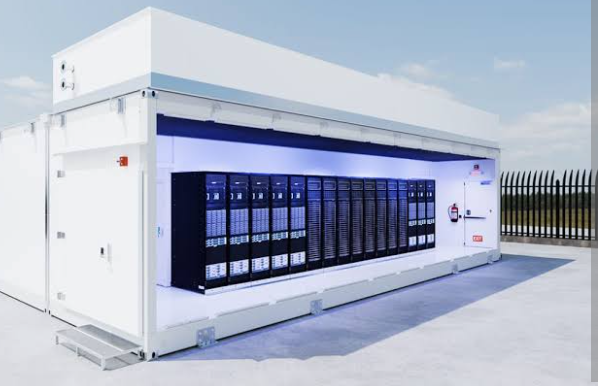

Modular data centers are increasingly viewed as one way to address the infrastructure constraints created by the rapid growth of AI workloads. Rather than replacing traditional hyperscale facilities, they can complement them by adding computing capacity more quickly and flexibly.
Here's how they help:
- Faster Deployment
Traditional data centers often take 2–5 years to plan, permit, and construct. Modular data centers are built from prefabricated components—such as power modules, cooling systems, and server rooms—that are manufactured off-site and assembled on location.
This can reduce deployment times to months instead of years, allowing organizations to respond more quickly to growing AI demand.
- Easier Scaling
AI infrastructure requirements can change rapidly as organizations train larger models or expand inference services.
Modular facilities allow operators to:
Add compute capacity incrementally.
Expand power and cooling alongside GPU deployments.
Avoid building significantly more capacity than is immediately needed.
This "scale-as-you-grow" approach can improve capital efficiency.
- Better Support for High-Density AI Hardware
Modern AI accelerators consume far more power than conventional CPUs. A single rack of AI servers may require 50–150+ kW, with some cutting-edge deployments going even higher.
Many modular designs are engineered specifically for:
Liquid cooling
Rear-door heat exchangers
High-capacity power distribution
Dense GPU clusters
This makes them well suited to AI-specific workloads.
- Reduced Supply Chain Bottlenecks
Because modules are standardized and factory-built:
Manufacturing can occur while sites are being prepared.
Quality control is more consistent.
Construction delays may be reduced compared with fully custom builds.
However, shortages of transformers, switchgear, GPUs, and skilled labor can still remain limiting factors.
- Deployment Near Power Sources
Power availability—not physical space—is becoming one of the biggest constraints for AI infrastructure.
Modular facilities can be placed:
Near renewable energy projects
Adjacent to existing substations
At industrial sites with available electrical capacity
At edge locations closer to users
This flexibility can reduce delays caused by limited grid capacity in traditional data center hubs.
- Improved Energy Efficiency
Many modular systems are designed with efficiency in mind through:
Advanced cooling technologies
Optimized airflow
Integrated power management
Waste heat recovery (in some deployments)
Lower energy consumption helps reduce both operating costs and environmental impact.
- Edge AI Applications
Not all AI workloads need to run in massive centralized facilities.
Smaller modular data centers can support:
Autonomous vehicles
Smart factories
Healthcare imaging
Telecommunications
Retail analytics
Running inference closer to users reduces latency and network bandwidth requirements.
Challenges That Modular Data Centers Don't Fully Solve
Despite their advantages, modular data centers are not a complete solution.
Key challenges include:
Power availability: Many regions lack sufficient grid capacity regardless of construction speed.
GPU supply: AI chips remain a major bottleneck.
Networking: Large AI clusters require extremely high-speed interconnects.
Land and permitting: Local regulations and environmental approvals can still slow deployment.
Cost: High-density AI infrastructure remains expensive, even when built modularly.
Outlook
As AI adoption accelerates, many industry analysts expect a mix of infrastructure approaches:
Large hyperscale campuses for training frontier AI models.
Modular expansions that can be deployed rapidly where power is available.
Edge modular facilities for low-latency inference and regional services.
Rather than replacing conventional data centers, modular data centers are likely to become an important part of a broader AI infrastructure strategy by enabling faster expansion, supporting high-density AI hardware, and providing greater flexibility in where computing resources are deployed.